
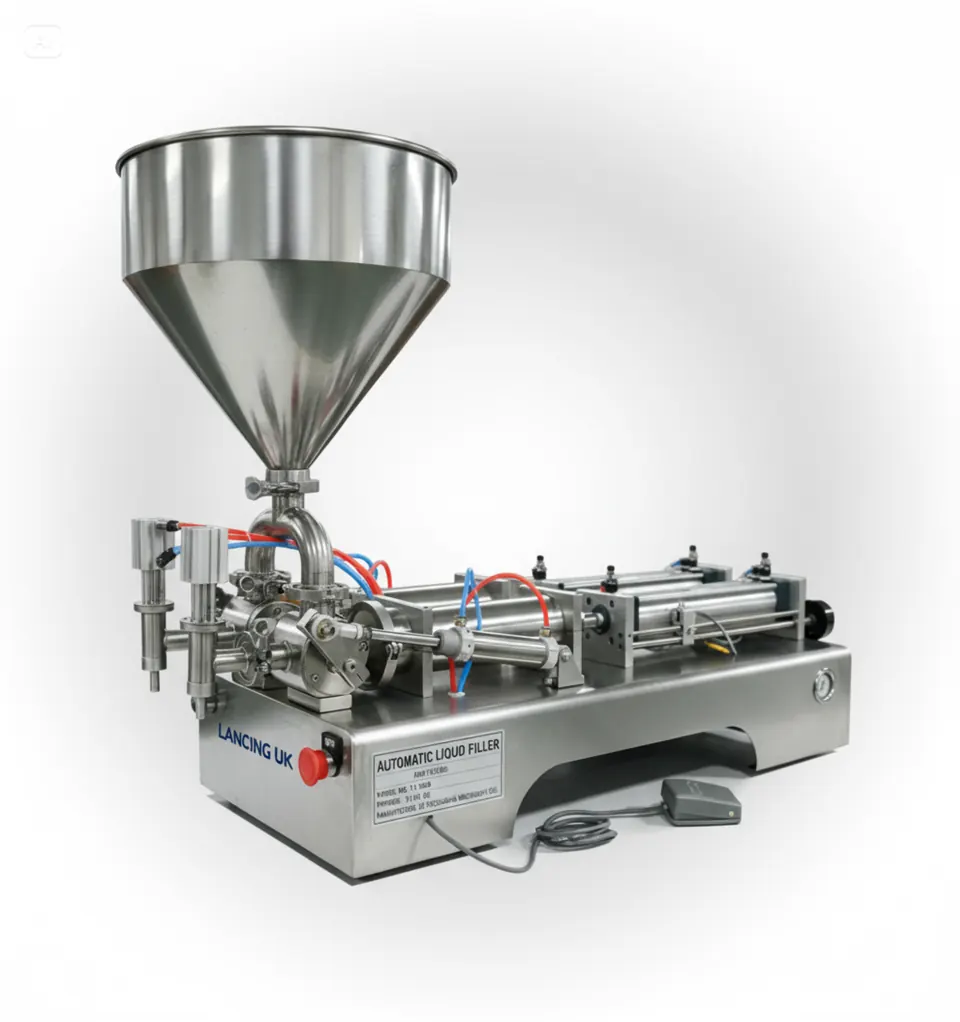
The choice is not simply manual versus fast. Semi-automatic, compact automatic and high-volume automatic systems create different requirements for labour, component feeding, formats, space, controls, maintenance and capital.
1. Understand the three practical operating models
Semi-automatic machinery normally asks an operator to present a container or component and initiate or supervise each cycle. Compact automatic systems connect selected stages with automatic transport while keeping the footprint and feeding arrangements modest. High-volume lines automate more of the component supply, inspection and end-of-line flow.
These are not rigid categories. A production system can combine automatic filling and labelling with manual cap placement or case packing. The right answer is the arrangement that meets the operating objective with manageable complexity.
2. Compare the options across the whole operation
Use a consistent set of production and commercial criteria rather than comparing headline machine speeds.
| Factor | Semi-automatic | Compact automatic | High-volume automatic |
|---|---|---|---|
| Best fit | Smaller batches and frequent variety | Growing repeat production | Sustained standardised volume |
| Labour | Direct cycle involvement | Monitoring and replenishment | Monitoring, replenishment and line support |
| Format flexibility | Often high for unusual work | Defined format range | Engineered format families |
| Footprint | Small individual machines | Close-coupled line | Larger with feeding and buffers |
| Capital | Lower initial equipment scope | Mid-level connected investment | Higher integration and automation scope |
| Controls | Local machine functions | Recipes and basic line logic | Coordinated controls, inspection and data options |
| Maintenance | Simpler but operator-dependent | Connected equipment skills | Planned technical support and critical spares |
3. Calculate labour by task, not headcount alone
Record what people actually do: load bottles, present caps, start cycles, check fills, apply labels, move finished packs, replenish materials, clean and change formats. Automation may remove repetitive direct handling while adding monitoring, setup and technical tasks.
Consider the full shift and the availability of suitable labour. A machine that can run unattended for one minute but needs constant cap or bottle replenishment has not removed the operating requirement.
- People and minutes per production task
- Replenishment interval and container capacity
- Quality inspection frequency
- Changeover and cleaning labour
- Fault recovery and technical support
- Potential redeployment to higher-value work
4. Use batch size and format stability as decision filters
Automatic machinery performs best when it runs long enough between changes to recover setup and cleaning time. Very short campaigns, one-off decorative packs or frequently changing customer components can favour simpler machinery or hybrid handling.
However, repeated small batches can still justify automation if changeovers are well engineered, recipes are reliable and the same adjustment sequence is used every time. Use real production history rather than assumptions.
5. Compare consistency and quality risk
Automatic dosing, capping, labelling and inspection can reduce operator-to-operator variation when the process and components are controlled. Semi-automatic equipment can still produce excellent results, but it may rely more heavily on training and concentration.
Automation also repeats problems consistently if the specification, samples or settings are wrong. Quality sensors, defined rejects and good change-control remain essential.
- Fill measurement and giveaway
- Closure application and container support
- Label position and code readability
- Inspection and reject confirmation
- Recipe control and approved settings
- Component-tolerance management
6. Include floor space and access
Semi-automatic machines may occupy less permanent floor space but require staging areas, operator movement and work-in-progress between operations. An automatic line uses more connected length but can reduce intermediate handling.
Measure the full working envelope: component loading, doors, guarding, change-part removal, product supply, cleaning and maintenance. Compact does not mean inaccessible.
7. Plan the skill and maintenance model
More automation introduces more sensors, drives, feeders, controls and interfaces. The operating team needs structured setup and fault-recovery skills, while maintenance needs documentation, backups and spares.
This does not automatically make an automatic line unreliable. It means maintainability and support should be part of the buying decision rather than added after installation.
- Named machine and line owners
- Operator training and competency
- Preventive maintenance intervals
- Critical spares and backups
- Remote and site support route
- Format records and tooling control
8. Consider staged automation
A staged plan can automate the constraint first, retain workable manual stages and reserve interfaces for later additions. For example, a business may automate filling and capping before adding labelling, case handling or bulk feeding.
Phasing works best when the future sequence, line height, controls, space and expected formats are considered in the first design. Otherwise the initial equipment can become an obstacle to the next stage.
- Stabilise the product and pack specification
- Automate the current capacity or quality constraint
- Reserve space and controls for the next module
- Collect production and loss data
- Add further automation when the operational case is proven
9. Make the decision with a scored business case
Score each option against sustained output, labour availability, quality, safety, flexibility, floor space, capital, operating cost, skill and future demand. Weight the criteria according to the business priority.
Test the sensitivity of the result. If the automatic option only works at an optimistic sales forecast or perfect efficiency, the staged route may be stronger. If a current labour or quality issue already constrains sales, the decision may be more urgent.
Key takeaways
- Choose an operating model, not simply a machine speed.
- Use real campaign sizes, labour tasks and format history in the comparison.
- Automatic lines still need operators, technical ownership and planned maintenance.
- Hybrid and staged automation can provide a controlled route from smaller batches to repeat volume.
- Protect future interfaces, space and format requirements in the first project.