CAPITAL PROJECT GUIDE

How to Build an Automatic Packaging Line ROI Business Case

A useful investment case connects engineering scope to accepted production output and real operating costs. It should show which benefits can be measured, which assumptions remain uncertain and what evidence will be used after commissioning to confirm the result.

How to Build an Automatic Packaging Line ROI Business Case decision sequence

ANSWER FIRST

How should an automatic packaging line ROI case be built?

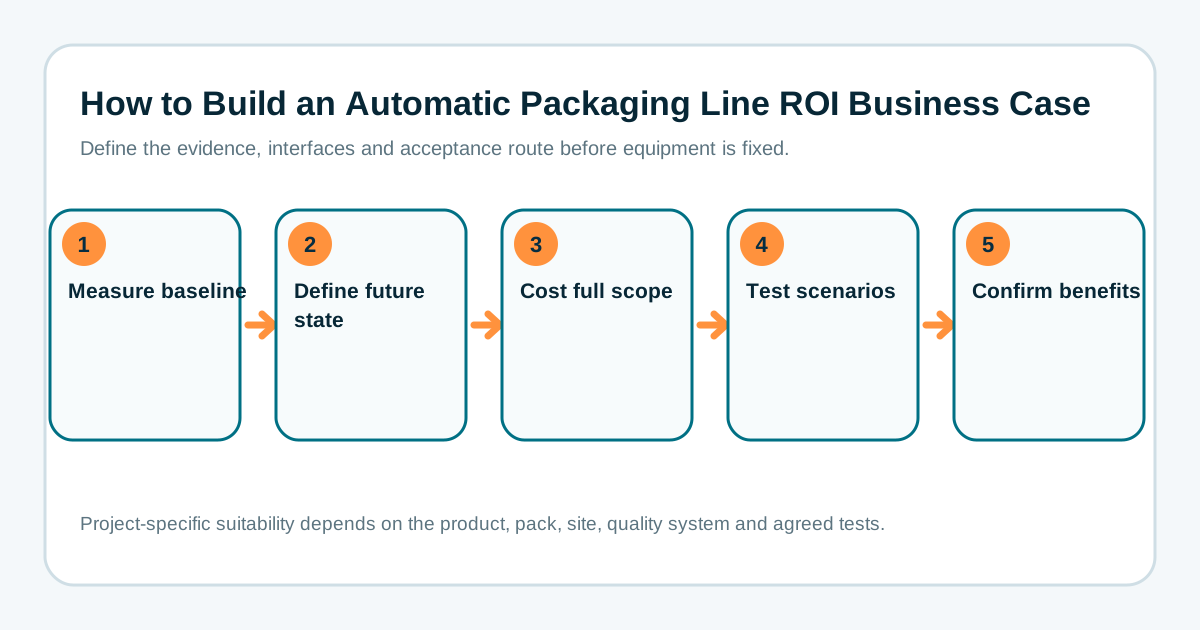
An automatic packaging line ROI case should compare the current process with a clearly defined future process using the same operating period, accepted-output definition and cost boundaries. It should include the full delivered project scope, not only the purchase price, and test more than one scenario for labour, output, waste, downtime, changeover and support. A range with stated assumptions is more credible than one precise payback figure based on headline machine speed.

Core business-case evidence
Evidence areaCurrent-state measureFuture-state basis
Accepted outputGood packs per planned hour or shift, excluding rejects and reworkAgreed line scenario, bottleneck, replenishment and short-stop assumptions
LabourPeople, hours and tasks by shiftRetained tasks, redeployment, supervision, replenishment and technical support
Waste and qualityProduct, packaging, rework and complaint costsOnly benefits linked to a defined control or process change
Downtime and changeoverFirst-cause stops, duration, format frequency and cleaning timePlanned change parts, recipes, access and recovery method
Project costCurrent running and maintenance costMachinery, integration, guarding, site work, trials, training, spares and contingency

Define benefits without double counting

Use accepted output, not nameplate speed

The business case should use the good packs that reach the agreed boundary during planned time. It should include the effects of feeding, replenishment, inspection, rejects, case handling and downstream stops. A faster individual machine does not create the same benefit if another stage constrains the complete line.

Separate labour removal from redeployment

Automation may remove repetitive handling while retaining people for material loading, quality checks, changeovers, cleaning and supervision. Record whether labour is genuinely removed from the cost base, redeployed to another value-adding task or retained to support higher output. Do not count all three as separate savings.

Value quality only when the control changes

A quality benefit should be connected to a specific improvement such as controlled filling, closure verification, code inspection or reject confirmation. Use current reject, giveaway, rework or complaint evidence where available. Avoid assuming a percentage reduction without a technical mechanism and an agreed measurement point.

Include lifecycle costs

Allow for planned maintenance, critical spares, software backups, operator and engineer training, utilities, consumables and foreseeable obsolescence. A lower initial quotation can produce a weaker investment case if essential integration, support or acceptance work is excluded and later purchased separately.

Use sensitivity ranges before approving one payback result

Build at least a conservative, expected and upside case. Change only defensible variables and show which assumptions have the greatest effect. Typical sensitivity factors include actual demand, shift pattern, sustained accepted output, labour availability, waste, changeover frequency, installation disruption and the time needed to stabilise production.

  • Use the same planned production period in every scenario.
  • Separate capacity value from cash savings that can be realised immediately.
  • Show the effect of demand below the proposed line capacity.
  • Include a contingency for site work and interface uncertainty.
  • Define the acceptance evidence that will confirm the expected operating case.

Use the automatic packaging line cost guide for scope layers and the line balancing and OEE guide for production evidence.

Questions a capital-approval team should ask

What production constraint is the investment intended to remove?

State the measured constraint and the value of removing it. If demand, upstream supply or downstream packing will remain the true limit, the proposed packaging line may need a different scope or a staged investment.

Which benefits are measurable after commissioning?

Choose a small set of agreed measures such as accepted output, labour hours by task, changeover duration, reject quantity, first-cause stops and maintenance effort. Define the baseline and the future count points before the project begins.

What happens if volumes or formats change?

Test the case against lower and higher demand, additional formats and different shift patterns. Flexibility has value only when the change parts, recipes, access, trials and validation needed for the future format are included.

How should risk be represented?

Record assumptions, evidence confidence, exclusions, retained manual tasks, site dependencies and acceptance criteria. A transparent risk range supports a better approval decision than hiding uncertainty inside one optimistic payback period.

Information to prepare for a useful discussion

Send the product and pack formats, target output, available footprint, existing machinery, site requirements and the evidence expected at acceptance. Lancing can then assess the project boundary, required trials and the most appropriate next engineering step.

Get line advice